Category: Arqueología

  • Playing to be a paleontologist. (Digging your own Ammonites)

    Playing to be a paleontologist. (Digging your own Ammonites)

    Today things are going about paleontology.

    From very tiny I knew what fossils were because in my house there is a small collection. Nothing about showcases or inaccessible sites, there, at the entrance, where you could hand touch and “study” them.

    Besides, the garden walls of my house contained small “treasures”. They were merely shells (mostly), but it was fun to inspect one by one in search of a most important finding.

    When I was older, my aunt (geologist) took me to a museum and  taught me about many others that I did not know.

    And so we come to this.

    taco (Large)

    It may seem like a piece of sand like any other, but as they say in the movies of our childhood “beauty is on the inside”.

    With a little digging work we discover our fossil:
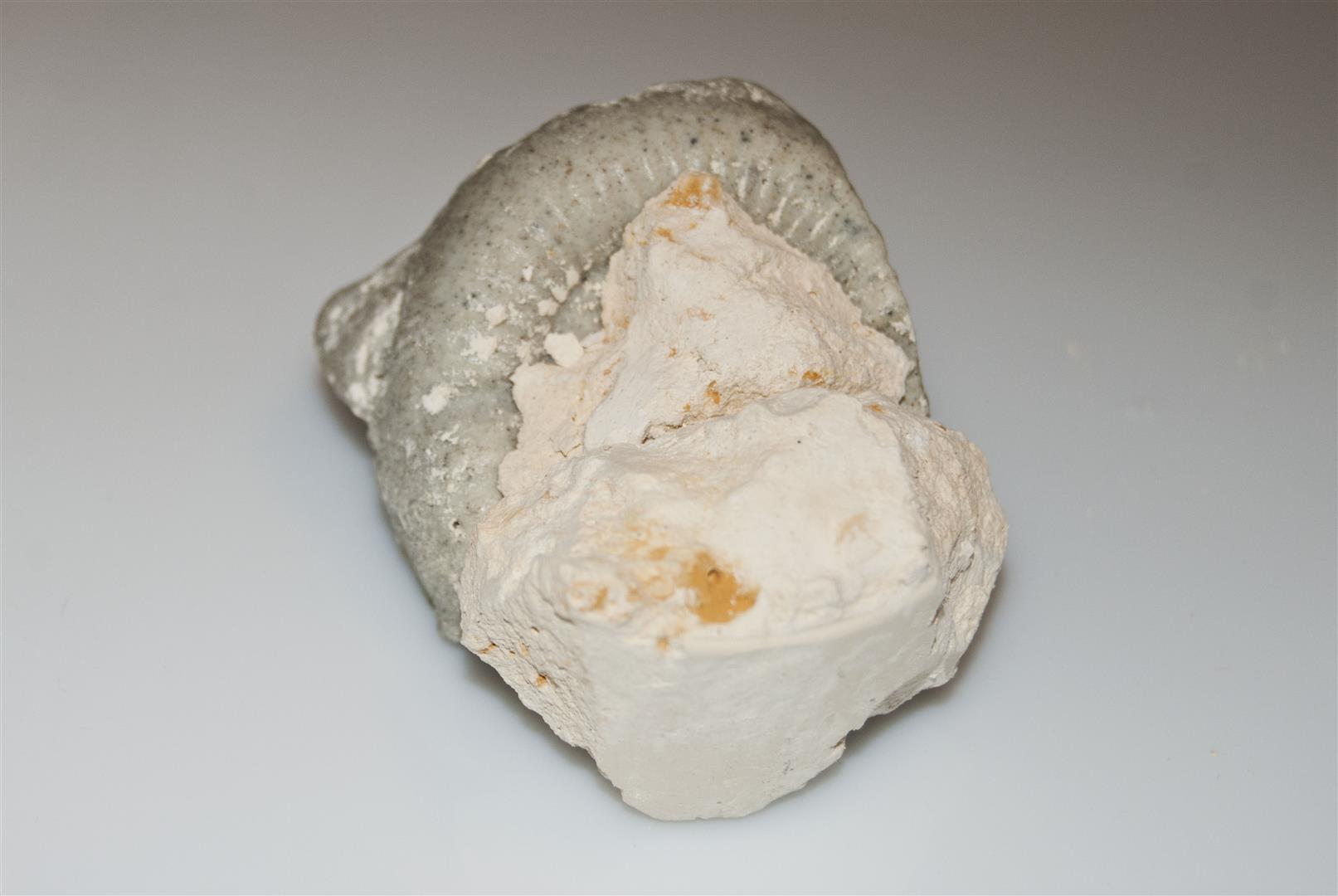
    medio (Large)

    “Ammonites are an extinct group of marine invertebrate animals in the subclass Ammonoidea of the class Cephalopoda. These molluscsare more closely related to living coleoids (i.e. octopuses, squid, and cuttlefish) than they are to shelled nautiloids such as the living Nautilus species. The earliest ammonites appear during the Devonian, and the last species died out during the Cretaceous–Paleogene extinction event.

    Ammonites are excellent index fossils, and it is often possible to link the rock layer in which a particular species or genus is found to specific geological time periods”

    (Wikipedia)

    When our daughter grows up, she will have their own treasures to unearth, learn with brush and hand peak and imagine the history of the little bug that that was buried millions of years ago.

    am2 (Large)amm1 (Large)

    A play and learning tool that will appeal to parents and children, teachers and students … and soon it will be available in our store.

    tres (Large)

  • Goddess Nammu and the Anunnaki

    Goddess Nammu and the Anunnaki

    Sumer was a historical region in the Middle East that formed the southern part of ancient Mesopotamia, between the floodplains of the rivers Euphrates and Tigris. The Sumerian civilization is considered the first and oldest civilization of the world. Although the origin of its inhabitants, the Sumerians, is uncertain, there are numerous hypotheses about its origins. The most widely accepted today argues that it would have happened no cultural break with the Uruk period, which would rule out external factors such as could be invasions or migrations from other distant lands.

    The Sumerians originally practiced a polytheistic religion with anthropomorphic deities representing cosmic and terrestrial forces in their world. During the middle of the third millennium. C., Sumerian deities became more anthropocentric and were “… nature gods transformed into gods of the city.” Gods like Enki and Inanna were seen as if An, god of heaven or Enlil, supreme god of the Sumerian pantheon had assigned them the range, power and knowledge.

    As a prelude to other divinities one special find:

    Nammu is the Sumerian Goddess of the primordial sea, creator of all things. She gave birth to An (heaven) and Ki (earth), as well as Enki, the master shaper of the world. She instructed Enki on how to create man, and helped him to form them from clay.

    NammuThe ancient astronaut theory, also known as paleocontact hypothesis, argues that aliens have visited the planet Earth and that these beings have been responsible, in varying degrees, of the origin and development of human cultures, technologies and religions (another way to call it is  alien creationism).

    A common variant of the idea is that most of the deities in the religions, if not all, are actually extraterrestrials, and their technologies were taken as evidence of their divine status.

    Sitchin argued that writings of the Sumerians existed that told the story of 50 Anunnaki, inhabitants of a planet called Nibiru, who came to Earth about 400.000 years ago with the intention of undermining raw materials, especially gold, for transport back to Nibiru. Because of their small number, soon got tired of his job and began to create workers for the mines by means of genetic engineering. After many tests, eventually created homo sapiens sapiens: the “Adapa” (model man) or Adam in subsequente mythology. Sitchin contended that the Anunnaki were active in human affairs until their culture was destroyed by global catastrophes caused by the abrupt end of the last ice age about 12,000 years ago. Seeing that humans survived and all they had built was destroyed, the Anunnaki left Earth after having given humans the opportunity and means to govern themselves.

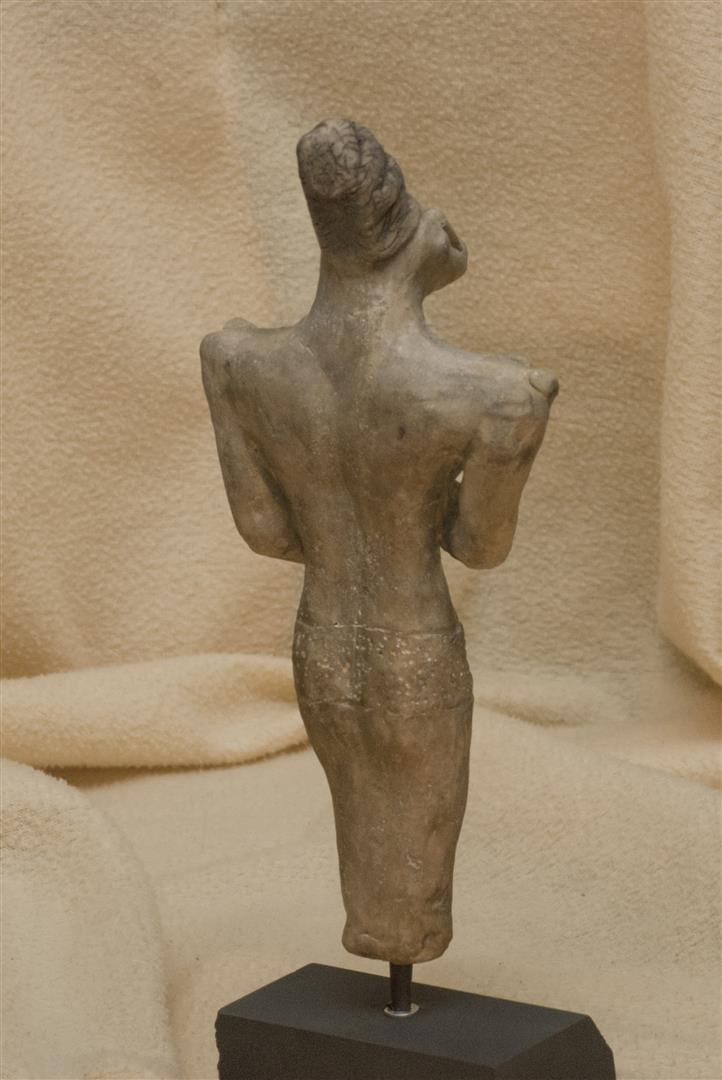
    a_51Nammu was the goddess who gave birth to Heaven and Earth, in the times of the Sumerians. The representation of this goddess is the one of a naked woman, straight, snakehead and breast-feeding a child. Their bodies are decorated with cupolas as a symbol of the underworld and magic method to ask the goddess the rebirth of what is in her womb. They also have broad shoulders, arms faced as symbol of protection. Great pubic triangle alluding to earthly paradise where life originates and resurrection.

    We present here our representation of the goddess Nammu. Shaped by the painter and sculptor Angel Corral for us (which from here we appreciate his help) taking inspiration on a statuette now disappeared from the Baghdad Museum.

    n15 (Large)

    n8 (Large)

    n2 (Large)

    The reproductions are made of polyurethane resin loaded with crushed marble and mounted on a wooden stand. They are hand painted and aged.

    Dimensions (without stand):

    22 x 10 x 6 cm

    With the base reaches about 30 cm high.

    Weight: Approximately 550 grams

    The finish is hand shaped and painte, so each one is unique and may have slight differences in color with to the photo.

    They are at your disposal in our store.

    References::

    http://es.wikipedia.org/wiki/Religi%C3%B3n_sumeria

    http://es.wikipedia.org/wiki/Antiguos_astronautas

    http://www.historiaantigua.es/sumer/tradicionreligiosa/tradicionreligiosa.html

    http://www.lamentiraestaahifuera.com/2010/11/24/la-diosa-nammu/

    http://www.expresionbinaria.com/la-historia-secreta-de-los-sumerios/

  • Royal Game of Ur

    Royal Game of Ur


    The Royal Game of Ur is one of the oldest known, next to the Egyptian game of Senet. Also called “game of 20 squares” and it was played in Mesopotamia in 2600 BC It is a game for two players, each with seven tiles (black and white) and three pyramidal dice.

    The board and pieces are based on the tablets found in the city of Ur, one of the most important cities of ancient Mesopotamia during the excavations in the 1920s by British archaeologist Leonard Woolley. Excavations continued until 1934 and there were found sixteen graves they called the “Royal Tombs of Ur”.

    The pieces found, (one of them is preserved today in the British Museum) consist on a wooden board with inlaid shell, red limestone and lapislazuli, small shell discs and three pyramidal dice, marked in two of its vertices.

    The twenty boxes are decorated with various designs, symmetrically distributed.

    All different similar boards  found, have in the same position the five rosettes, so they are considered special boxes. Other tables are decorated with “eyes of luck” points and concentric circles.

    The original rules of the game are unknown but there are several possible reconstructions based on a clay tablet with cuneiform writing (Babylonian origin of 177-176 BC) that suggests that it was a “persecution” game as Senet, predecessor of today Parcheesi and backgammon.

    The two players move their pieces across the board according to their score on the dice.

    Here we expose one of the versions, based on the interpretation of the British Museum:

    Objective:

    Complete the tour with seven tiles before your opponent

    How to play:

    The score of the dice according to the number of vertices labeled as follows:

    – An unmarked vertex: One point, the turn passes to the opponent.

    – Two unmarked vertices: Zero points, the turn passes to the opponent.

    – Three unmarked vertices: Four points, and roll again.

    – Three sharp corners: Five points, and roll again

    With the first roll of the dice we resolve who starts the game.

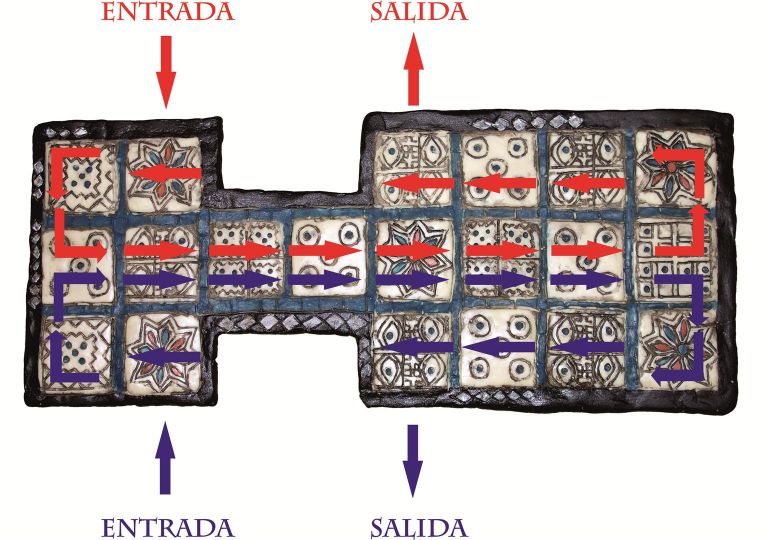
    A chip on the board enters the input box if we get a roll of 4 or 5 points.

    Once on board, the chips make their journey according to the score of the dice.

    When the chips are in the middle row can be attacked if an opponent’s piece falls into the same box, so that the attacked piece will be removed from the board  to start again.

    The rosette boxes are safe squares rosette, the chips are in a rosette can not be attacked.

    To exit the panel a piece has to fall exactly at exit square, If the score is larger, travel in the opposite direction to completion, once there, the tab will travel when I get a score of 4 or 5.

    Long version:

    Once in the exit box, we turn to the piece and follow the dash in reverse, to finish the tour of the input box. In this game mode, the chips may only be attacked by other going in the same direction.

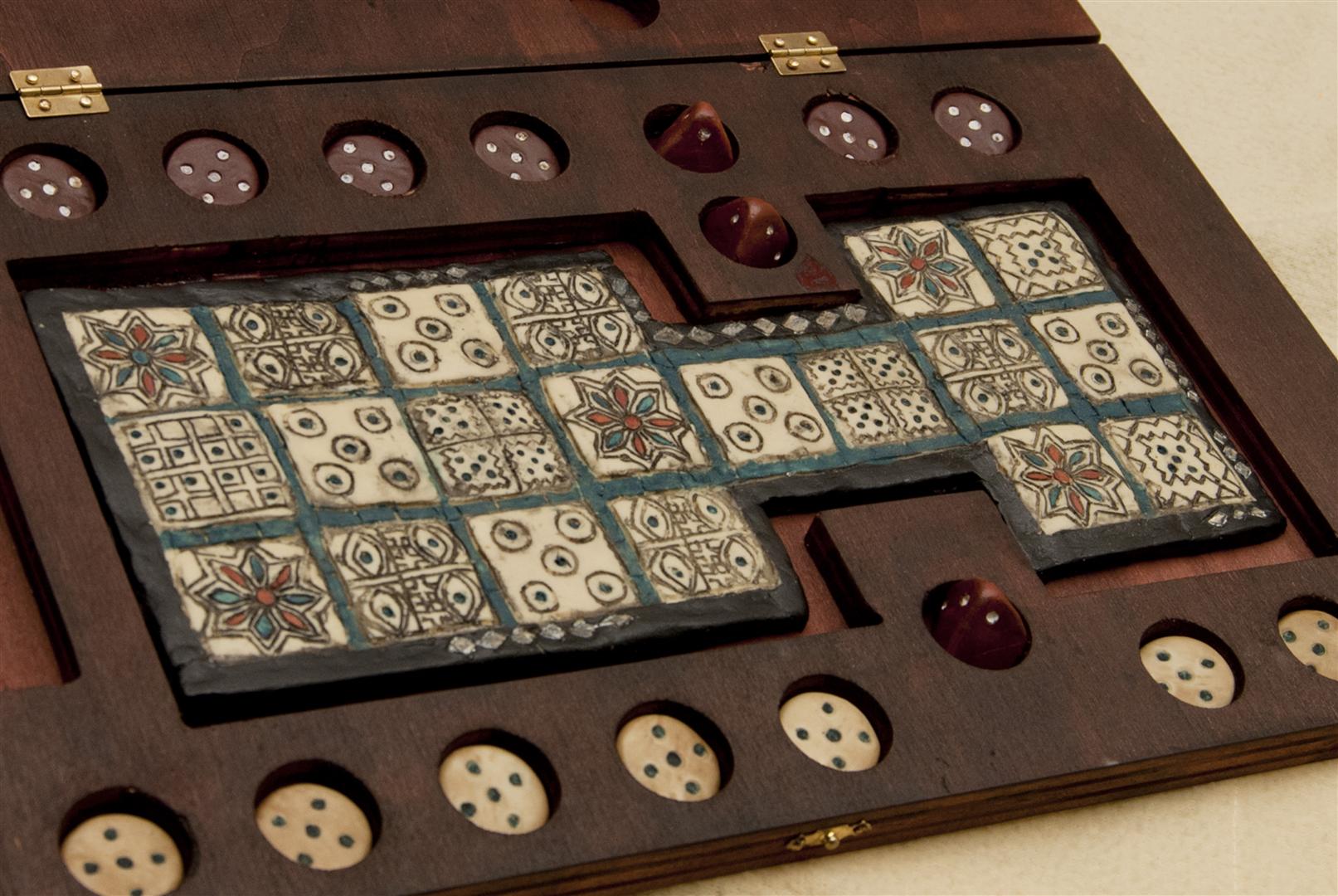
    We present here our interpretation of the board and pieces.

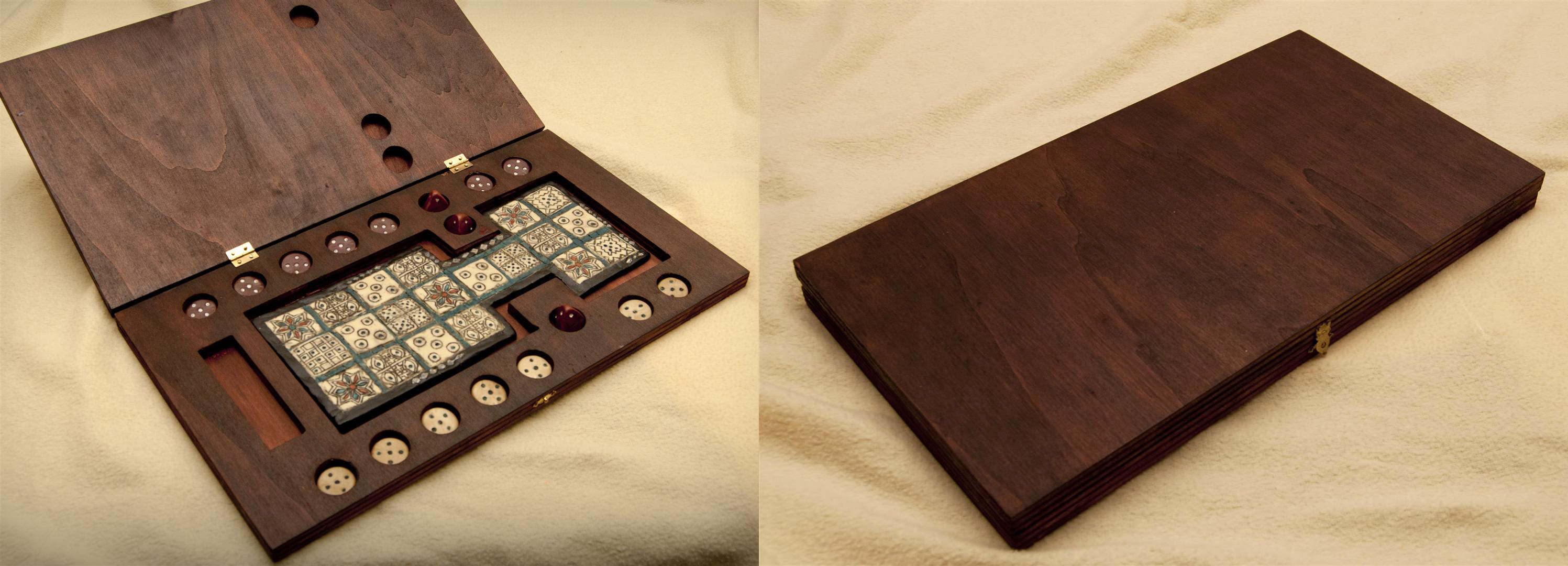
    This is a reproduction hand painted resin.

    It comes in a matching wooden box, with compartments for the different pieces.

    Wooden box is not available now.

    Available in our store.